

Human progress is built on a ratchet effect of collective learnings recorded by those who came before us. Over centuries we’ve recorded things you can hear, see, touch, smell and taste.
Oral societies carried their knowledge in memory, which drifted with every retelling, and we ended up with radio and (VC propaganda) podcasts. Cave walls led to paintings, tapestries and now Reels-slop. Scripture led to books and the Obsidian second brain people insist on telling you about.
Each step made the record a little less lossy. More durable, more portable, less dependent on who was doing the remembering.
Importantly, this process has always been rate limited at both ends.
-
Capture was limited because we could only record what we noticed, had time for and could put into a human-legible form.
-
Processing was limited because even the context we did capture mostly sat unread, or in the case of the Bayeux Tapestry, behind a two-hour queue.
But what happens when both rate limits lift at the same time?
Lifecording is becoming a category because capture is getting frictionless and processing is no longer scarce. It’s increasingly obvious we’re in one big race to capture the context of you, and as I’ve written before owning the hardware let’s you capture this information at source.
Processing
Capture is pointless if we’re still rate-limited by our ability to process this information. Last month it felt like consumers finally got a taste of what happens when the ability to do stuff becomes abundant. Three months ago I didn’t think I’d be giving an agent my Amex and permission to spend $2k chasing Glastonbury tickets (the real AGI eval). Unfortunately CAPTCHAs are still quite good.
I’m not the only one handing over the card. Meta launched Muse in early September; 3m downloads later the stock has popped and Alexandr Wang is on an X shitposting heater. Of course, Muse arrives with Instinct already at a $10bn valuation and 40% of its users connecting a credit card by week three. And lest we forget, these are all riffs on OpenClaw, whose founder OpenAI absorbed in February and helped hatch Dots last week.
For me, the most interesting UX shift is entering the proactive era. You set long-term goals and the agent pre-empts the needs. [insert fungible agent brand] builds the plan, coordinates time and resources, then advances the work on its own.
Compute goes up, obviously. But also how we talk to these things is changing too. On Invest Like the Best, the 23 year old founder Noah Shinn said over 90% of some users’ messages now arrive by voice, often via an iPhone action-button shortcut that skips unlocking the phone altogether. Natural interfaces is how we will communicate with AI, which is perhaps why the latest video models anthropomorphising AI from the likes of Tavus are rejected by some as creepy.
So the end goal of these platforms is to spark volition: to act before you’ve decided you want something. But an agent can only pre-empt the needs it can see. Abundant processing creates more demand for capture.
Capture
There are plenty of ways to slice the land grab for new context, but right now I see it happening across three layers: the body, the home and work.
Body
Oura may have just delayed its IPO, but it remains a flag bearer for wearables 1.0: the wave that normalised obsessing over HRV, VO2 max, cringe corporate step challenges and edge behaviours like non-diabetics plugging in a CGM.
Hopefully the future gets weirder. We’re heading into a new era of consumer bio where micro-dosed GLP-1s are normal, peptides augment our sleep, bald jokes disappear, teeth regrow and we start reading, perhaps even rewriting, our own DNA. Continuous hormone monitors are coming down the pipeline, and each new analyte we can sense unlocks something new to monitor (and, inevitably, optimise).
That’s just inside the body. More immediately, there’s a battle to capture what happens around it. Meta’s Reality Labs bet is looking prescient: 7m+ smart glasses sold in 2025 alone, more than triple the previous year. At Connect, Zuck set out his stall for AI delivered through these interfaces, alongside Charm, a Tamagotchi-like thing from the team Meta bought from Limitless. The same vision is playing out across a cluster of novel form factors for AI:
-
Rings: Stream
-
Pins: Humane (RIP)
-
Headphones: Plaud, and possibly AirPods with cameras
Home
Alexa was wave one, and despite being relegated to a radio and timer, it was an important precursor to what comes next. In elder care, Sensi monitors via audio and Teton detects falls via infrared, while Ring doorbells and their many clones front rows of Victorian terraces across London. Matic maps your home to clean it, and with that map it’s moving towards more capable form factors. Even the router is a sensor now. The IEEE ratified 802.11bf in 2025, making sensing a native Wi-Fi capability, and Comcast has turned millions of Xfinity gateways into camera-free motion detectors.
Now step inside the bathroom. Smart toilets like Throne monitor your gut health. BiomeSense‘s lab-in-a-box sits next to the loo, pulls microbiome DNA from used loo paper and posts samples off for sequencing once a month. There might also be useful DNA samples from your toothbrush, or perhaps simply a few thousand daily images from Dyson to keep the plaque away, while Lumeria tracks your skin over months.
Then the home starts acting on what it knows. At Stripe Sessions in April, Nat Friedman, now orchestrating much of Meta’s AI product strategy, described his own experience building an ambient home on cameras, with integrations that could even redirect his Tesla. And as of this weekend, Muse Home Link, a little USB-C dongle, plugs Muse straight into your home. And don’t forget, the other guy orchestrating Muse doesn’t want to have kids until BCIs work.
nOnEpcbl.@nonepcbl
the biggest shift in ai isn't better answers
it's ai gaining context – and then acting on it
one developer replaced google home with a local llm connected to his entire house
now instead of asking: "what's the weather?"
he asks: "do I need a coat today?"
the ai checks live…

Work
Everybody is building a version of a “context layer” for the enterprise. The riff goes: businesses aren’t rate limited by frontier model intelligence, but by their ability to extract the tacit knowledge buried in their workflows and work out which ones are worth automating. An argument to which I am sympathetic.
The approaches vary:
-
Mining latent data: typically unstructured documents like Reducto or Extend
-
Screen recording: Highlight, Recall. Meta tried this on its own staff, logging keystrokes, clicks and screenshots to train its agents, and was rewarded with a petition and a staff revolt.
-
New hardware: Transfyr and Descrai in the lab, or Navigate AI in trade services
-
More proactive methods: like having AI interview all your employees (Stealth) or reimagining of Bridgewater’s ambient, record-everything office for the masses (Stealth)
Email remains the key repository for much of this. A natural bull case for Microsoft owning the identity layer plus Outlook. Scout, launched at Build this year, is their nod to OpenClaw wrapped in enterprise controls, with each agent running under its own governed Entra identity. It’s also why Google, with Gmail, Gemini Spark and an Apple partnership, will still flex their muscles.
Will this just be a sport of kings?
Right now it feels like the majors are converging on some combination of (1) a device on the body, (2) access to your digital footprint, and (3) an agent that acts.
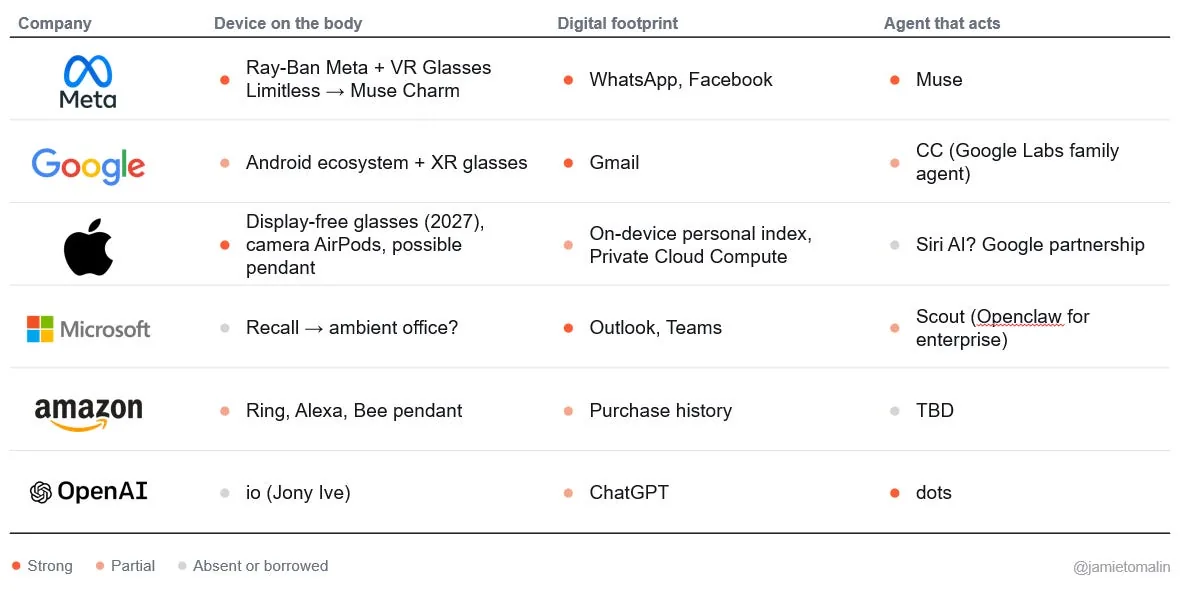
The debate of their relative positioning is fun, but I’ll leave that to others to opine on. I’m more interested in (A) if this is actually a good thing?! and (B) if all of these devices are going to proliferate on an exponential, then are there interesting second order opportunities in optics and waveguides, image sensors, MEMS microphones, ultra-low-power compute, connectivity, batteries etc.
On the latter, it seems yes, but perhaps played better immediately in the public markets and with the context that the sharps from BofA estimate over 80% of companies in the AI glasses supply chain are based in China. So …
Is this actually good?
The bear case is extrapolating to some 1984-style future policing thoughtcrime. Or for the acquainted, Black Mirror’s 2011 episode “The Entire History of You”, where almost everyone wears a Grain: a small implant behind the ear that records everything they see and hear. Memories can be zoomed into, replayed and scrubbed back to audit anyone. It makes good TV and a CCP wet dream, but I’m rather more techno-optimistic.
First, while I sympathise with the privacy hawks, revealed preference says most people don’t care all that much. London runs roughly 628,000 cameras, about 68 per 1,000 residents, and is the only Western city in the global top 20. I have to acknowledge Flock Safety’s recent political backlash & Norway’s stance on ‘perv glasses’, but I’d wager the same crowd that scrawled “surveillance capitalism” over Friend’s subway ads will eventually be downloading Muse in their millions. That said, I’m curious whether a new cohort of consumer privacy companies emerges, à la Deveillance or Cape.
Much of the angst of modern life stems from the paralysis of abundance. We have so many options that it’s easy to get caught in an anxiety-fuelling loop of sub-optimising your fitness, finances, career, relationships etc.
We are undoubtedly in the “Age of Alexandria”, with near-unlimited access to knowledge and optionality over how we live. The BBC has reported that the average Western city-dweller now takes in as much data as someone in the 15th century encountered in a lifetime. Optionality paralysis used to be the preserve of the aristocracy. Now everyone has it: the grand tour (to Australia), the [ultra]marathon, the tattoo, or opting out of capitalism to join the downwardly mobile elite.
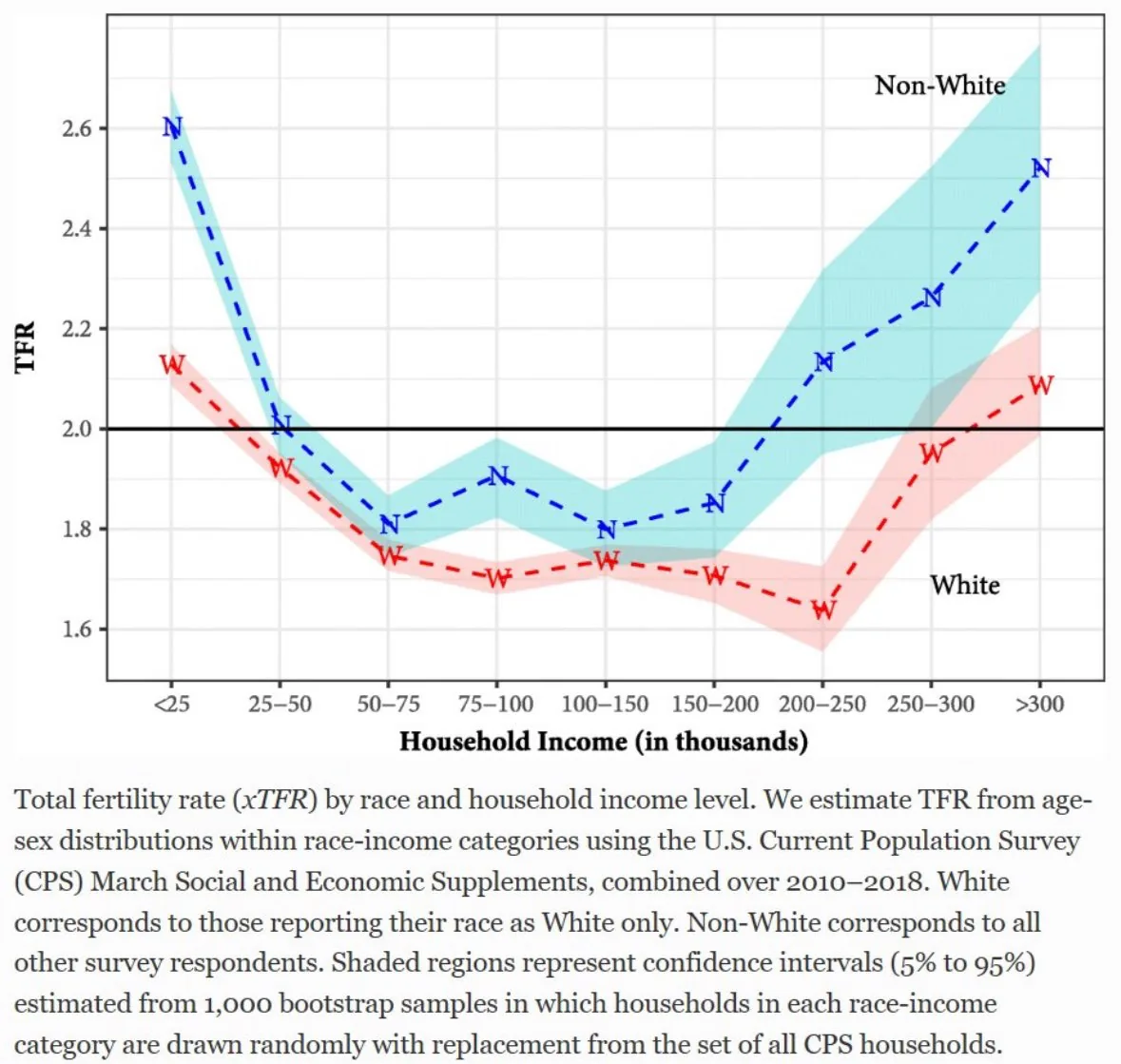
The chart below has intrigued me for a couple of years. It comes from a 2020 paper by Hauer and Schmertmann and suggests fertility rises at both ends of the income barbell. Like most literature it’s imperfect, but I read income as a rough proxy for some weighting of agency + IQ, and the chart hints at a curse of the messy middle:
-
At the bottom, people just get on with it rather than using a spreadsheet to govern if they can afford a child. The anon on tech X would call this Retardmaxxing
-
At the top, they pay to have the frictions removed (tutors, private bankers, personal assistants, trainers … boarding school)
-
In the middle, you’re running spreadsheets, sub-optimising, constantly striving and losing sleep over school catchments.
I’m not saying an AI agent solves fertility. It’s clearly a highly multivariate problem, and short of an extreme productivity or physical AI boom, the hard constraints remain. But if lifecording works, could a context-rich agent do for the messy middle what money does for the top, and absorb the friction?
If you are thinking about these themes please drop me a note on jamie@triplepoint.vc.