
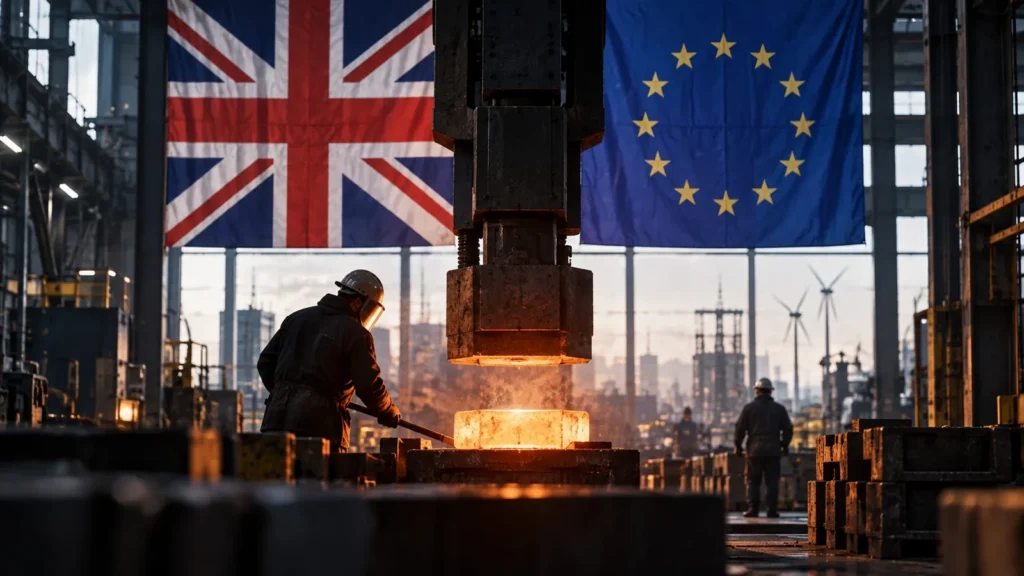
A new generation of manufacturing companies is using software, AI and robotics to bring more production capacity back to the West. In the US, companies such as Hadrian, Senra and Atomic are applying this model to aerospace, defence and industrial supply chains, reducing lead times and making skilled labour more productive. Europe has capable companies pursuing the same approach, but the cohort is smaller and generally less mature.
The US has a headstart
The US venture market has become more comfortable funding businesses that resemble traditional industrial companies rather than the software startups that dominated the past decade. a16z’s American Dynamism strategy raised $600m in 2024 and targets manufacturing, supply chain, industrials, aerospace and defence.
- Hadrian builds highly automated aerospace and defence manufacturing facilities that combine software and robotics with skilled labour. Its proprietary Opus software platform supports four sites with nearly 3 million square feet of space; customers include Lockheed Martin, RTX and Anduril.
- Senra Systems applies a similar model to wire-harness production. It raised $65m in Series B funding in July 2026 and plans to scale output from 1,000 harnesses a month to 10,000 by 2027.
- Atomic Industries focuses on tool-and-die manufacturing, leveraging a $17m seed round raised in 2023 to build an AI-enabled facility in Detroit.
- Layup Parts applies the model to composites. Following a $42m Series A in June 2026, the 60-person team is expanding its workforce and production facility.
While these companies target different parts of the supply chain, they’re all following the same underlying thesis: instead of licensing software to existing manufacturing companies, they build their own automated production lines and operate directly as suppliers.
Why now?
Defence demand is booming.
EU-27 defence expenditure reached €418bn in 2025 and is projected at €454bn for 2026, according to the European Defence Agency. The European Defence Industry Programme is taking shape, with the Commission’s 2026 EDIP work programme allocating €1.5bn, including over €700m to scale domestic defence output. There is now much more money being directed towards production capacity, along with explicit incentives to build part of that capacity in Europe.
Sovereignty and geopolitical uncertainty
Heightened geopolitical tensions and trade-policy uncertainty have underscored the risks of critical supply-chain dependencies. European policymakers and industry leaders increasingly view domestic manufacturing capability as one part of strategic autonomy and resilience.
European defence, security and resilience startups raised $8.7bn in 2025, up 55% from 2024, according to Dealroom and the NATO Innovation Fund. The sector represented 13% of total European VC investment and 43% of European deep-tech funding in 2025.
If European defence companies are going to build more hardware, someone needs to manufacture the components. That includes relatively unglamorous things like machined parts, wiring, composites, electronics packaging and tooling.
Europe also still has a substantial industrial base.
Central and Eastern Europe in particular have large manufacturing ecosystems and established pools of engineering and technical talent. Europe needs to use this core advantage of existing manufacturing capabilities and supplier networks to reinvigorate its industry with new technology.
What Europe actually has
Despite lagging behind the US, several European startups are actively executing this playbook:
- Isembard is a close European analogue to Hadrian. Founded in London in 2024, it is building a network of precision-manufacturing facilities and its MasonOS software platform. It raised a $9m seed round led by Notion Capital in April 2025, followed by a $50m Series A led by Union Square Ventures in March 2026.
- Q5D in the UK is developing robotic systems for wiring and product electrification. In 2025 it raised $13.5m, including a $10.9m Series A co-led by Lockheed Martin Ventures.
- Daedalus in Germany is building AI-enabled precision-manufacturing facilities. It raised a $21m Series A in 2024, led by NGP Capital.
- CloudNC in the UK is taking a more software-led approach to CNC manufacturing and raised a $45m Series B led by Autodesk in 2022.
- In additive manufacturing, Alloyed (UK) develops metal printing technology, while MX3D (Netherlands) raised €7m in a 2025 Series A led by EDF Pulse Ventures to build robotic 3D printing systems.
- SAEKI in Switzerland raised $6.7m in 2025 to develop autonomous manufacturing systems for large components.
While Europe has capable companies in machining, additive manufacturing, industrial software, and automation, we still remain in the early innings of rebuilding our industrial capabilities.
Opportunities for European founders
1. Tool-and-die manufacturing
Atomic Industries provides a clear US example, using software and robotics to automate tool-and-die production. Europe has strong existing tooling suppliers, but most still rely on manual shop-floor workflows and fragmented job scheduling. There is an opportunity in Europe to build or re-equip local toolmaking shops with automated CAD-to-CNC programming, sensor-monitored machining, and centralized quality control.
2. Wire harnesses
Q5D in the UK and Senra Systems in the US show how manual wire-harness production remains a constraint across aerospace, defence and automotive. Harnesses are still largely assembled by hand: a labour-intensive process that is difficult to scale, standardise and automate. Software and robotics can reduce that bottleneck by making production faster, more repeatable and less dependent on scarce specialist labour.
3. Additive manufacturing for production
Europe has many additive equipment manufacturers, but few vertically integrated suppliers operating large scale 3D printing facilities for finished parts. There is an opportunity in running automated metal and polymer printing plants dedicated to certified aerospace and defence components.
VulcanForms provides a relevant US point of comparison. It combines additive manufacturing, machining, automation, inspection and software rather than simply selling printers. To compete with traditional machining, additive plants must automate post-processing, heat treatment, and non-destructive inspection to reduce unit costs as output grows.
4. Composites
Layup Parts is an interesting US example of a company trying to make composite-part production more accessible and repeatable. Europe has large aerospace, automotive and motorsport industries, but the manufacturing base remains fragmented.
There are European companies working on adjacent technologies. For example, Austrian Fiber Elements raised €2.6m in 2025 to automate basalt-fibre manufacturing, although its initial market is construction rather than aerospace or defence.
5. Semiconductor packaging and hermetic sealing
High-reliability microelectronics, ceramic packaging, and hermetic sealing are essential to next-generation hardware. Europe already has companies operating in hermetic packaging. ALTER, for example, provides ceramic and metal hermetic packaging for aerospace and defence applications.
If demand for radiation-hardened and high-temperature electronics grows, European defence and space primes may need more local capacity for ceramic packaging, wire bonding and leak testing.
What makes these businesses viable for venture?
To deliver venture returns, software and automation must measurably reduce unit production costs, cycle times or setup overhead. For energy-intensive processes, European electricity costs can be a cost disadvantage. That may make precision machining, assembly, electronics, harnesses and other forms of advanced manufacturing more attractive than commodity processes where energy is a large share of the cost base.
European defence procurement remains fragmented, and national preferences continue to matter. EDIP is intended to improve cross-border cooperation and European production, but it does not remove the underlying complexity. Founders must navigate a different procurement environment from that of software companies, rather than assume that rising defence budgets will translate directly into orders.
At Triple Point, we’re looking for founders who are rethinking established industrial businesses with new technology. If you’re building in manufacturing, or think I’ve missed something important, I’d love to hear from you at max@triplepoint.vc.